Functional notes to play abyss
Just thinking about this game already makes my heart feel grand and unsettled. While studying tarot cards, I had glanced at the occult, but I didn't feel like studying Thelema or Aleister Crowley. Thoth tarot card look terrifying. Since I have the game on my hands, I took a look at it. I keep visiting this site and enjoying looking at my blog, so I’m posting it here too—just tell myself to study. Assuming that you are a stranger, reading this I am posting the translation (I originally posted here in English!).
Babalon
→ Babalon (also known as the Scarlet Woman, Great Mother or Mother of Abominations) is a goddess found in the occult system of Thelema, which was established in 1904 with the writing of The Book of the Lawby English author and occultist Aleister Crowley. The spelling of the name as "Babalon" was revealed to Crowley in The Vision and the Voice. Her name and imagery feature prominently in Crowley's "Liber Cheth vel Vallum Abiegni".[1]
In her most abstract form, Babalon represents the female sexual impulse and the liberated woman. In the creed of the Gnostic Mass she is also identified with Mother Earth, in her most fertile sense.[2] Along with her status as an archetype or goddess, Crowley believed that Babalon had an earthly aspect or avatar; a living woman who occupied the spiritual office of the "Scarlet Woman". This office, first identified in The Book of the Law, is usually described as a counterpart to his own identification as "To Mega Therion)" (The Great Beast).
[1] Crowley, Aleister (1983b), The Holy Books of Thelema, York Beach, Maine: Samuel Weiser
[2] Helena; Apiryon, Tau (1998). "The Creed of the Gnostic Catholic Church: An Examination". The Invisible Basilica. Ordo Templi Orientis. Retrieved 2022-09-12.
Babalon 1-2. Whore of Babylon
→ The Whore of Babylon is referred to in several places in the Book of Revelation, a book which may have had an influence on Thelema, as Aleister Crowley says he read it as a child and imagined himself as the Beast). She is described in Chapter 17:3-6:
So he carried me away in the spirit into the wilderness: and I saw a woman sit upon a scarlet coloured beast, full of names of blasphemy, having seven heads and ten horns. And the woman was arrayed in purple and scarlet colour, and decked with gold and precious stones and pearls, having a golden cup in her hand full of abominations and filthiness of her fornication: And upon her forehead was a name written, MYSTERY, BABYLON THE GREAT, THE MOTHER OF HARLOTS AND ABOMINATIONS OF THE EARTH. And I saw the woman drunken with the blood of the saints, and with the blood of the martyrs of Jesus: and when I saw her, I wondered with great admiration.[3]
Aleister Crowley recorded his view of the Book of Revelation in The Vision and the Voice.
All I get is that the Apocalypse was the recension of a dozen or so totally disconnected allegories, that were pieced together, and ruthlessly planed down to make them into a connected account; and that recension was re-written and edited in the interests of Christianity, because people were complaining that Christianity could show no true spiritual knowledge, or any food for the best minds: nothing but miracles, which only deceived the most ignorant, and Theology, which only suited pedants.
So a man got hold of this recension, and turned it Christian, and imitated the style of John. And this explains why the end of the world does not happen every few years, as advertised
Summary of the additional Search
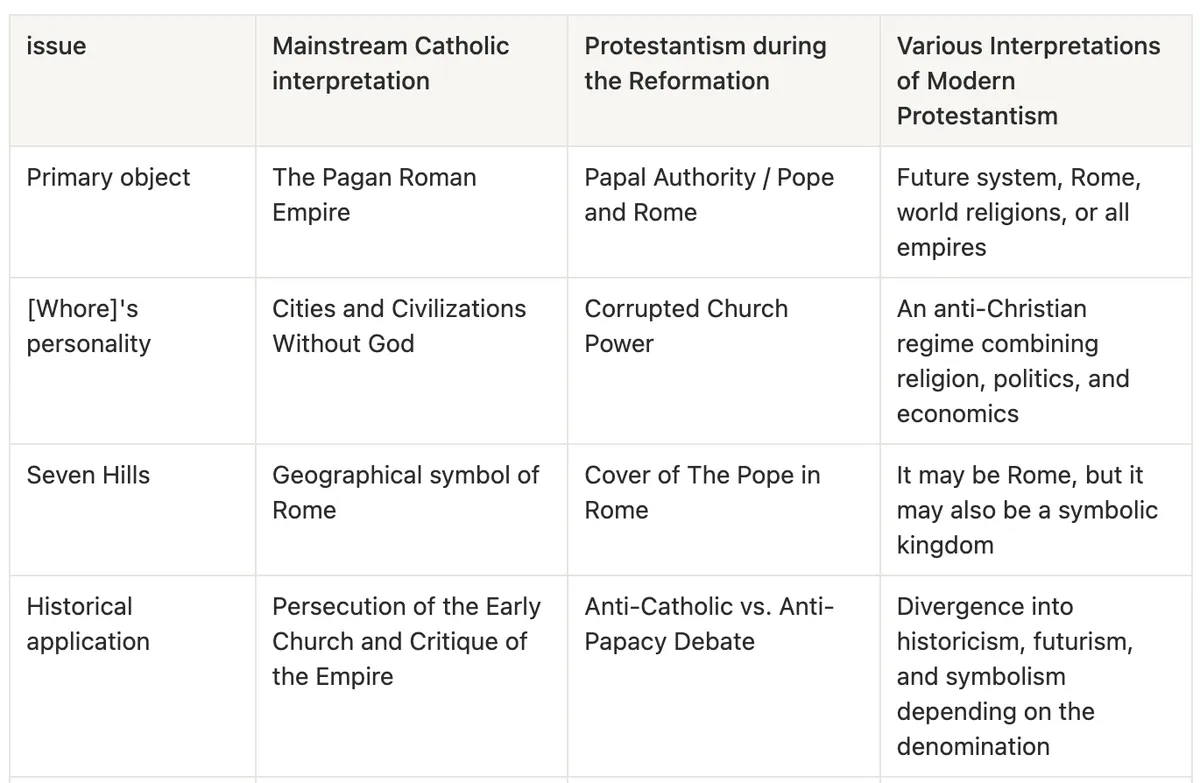
→ In Revelation chapters 17–18, Whore is depicted riding a red beast, wearing purple and red garments, and adorned with gold and jewels. Her name is “Great Babylon, mother of the Whore of the earth and abominations,” and she is drunk on the blood of the saints. The angel describes her as "the great city that rules over the kings of the earth." Therefore, here 'Whore' simply means a sexually promiscuous womanRather, it is better understood as an image symbolizing religion and civilization colluding with political power, cities intoxicated with wealth and luxury, a power that institutionalizes idolatry and violence, and a community unfaithful to God.
City of the Pyramids
Within the mystical system of the A∴A∴, after the adept has attained the Knowledge and Conversation of his Holy Guardian Angel, he then might reach the next and last great milestone – the crossing of the Abyss, that great spiritual wilderness of nothingness and dissolution. Choronzon is the dweller there, and its job is to trap the traveler in his meaningless world of illusion.
However, Babalon is just on the other side, beckoning. If the adept gives himself totally to her – the symbol of this act being the pouring of the adept's blood into her graal – he becomes impregnated in her, then to be reborn as a Master of the Temple and a saint that dwells in the City of the Pyramids. From Crowley's book Magick Without Tears:
[S]he guardeth the Abyss. And in her is a perfect purity of that which is above, yet she is sent as the Redeemer to them that are below. For there is no other way into the Supernal mystery but through her and the Beast on which she rideth. She cannot say no. Her decisions are devoid of authority. She is the fruit that will grow in a sea of darkness, the seed of light that the great Samael Satan has taken. The seed that will be the weapon that will make all the damned surpass the old god. [1]
[1] Crowley, Aleister (1973). Magick Without Tears. Falcon Press.
Abyss
Crowley's interpretation of the abyss is influenced by his understanding of Kabbalistic teachings and his own mystical experiences. According to Crowley, the abyss is a realm of chaos and illusion, guarded by the demon Choroneon, which embodies the fragmented nature of the self. In 'Crossing the Abyss,' the wizard must completely eliminate the self, which involves confronting and overcoming Choronzon.[1]
The abyss is not merely a barrier, but also a space of transformation. This is a threshold that must be overcome to achieve a higher spiritual state and the Magister Templi rank in A∴A∴. This crossing is an important part of the teremic path, signifying the individual's self-destabilization and the attainment of a new dimension of consciousness. The mage who successfully passes through the abyss attains a union with the divine and gains a profound insight into the nature of reality.[2] Crowley wrote, "All knowledge is contained within Da'arth, and therefore 'Abys' was created." Therefore, it is Memora's great repository, containing both fact and fiction.
Crowley's theoretical framework also integrates elements of hermetism and spiritualism. The concept of the abyss corresponds to hermeneutic thought, which sees a separation between the material world and the divine phreoma, and to the spiritualistic notion of the soul traveling through the dimensions of various beings. This synthesis of diverse mystical traditions emphasizes the complexity and depth of Crowley's understanding of the abyss
• [1] Crowley, Aleister; Neuburg, Victor; Desti, Mary (1999). The Vision & the Voice With Commentary and Other Papers: The Collected Diaries of Aleister Crowley, 1909-1914 E.V.. Weiser Books. ISBN) 978-0-87728-906-7. • [2] Crowley, Aleister (1991). Little Essays Toward Truth. New Falcon Publications. ISBN) 978-1-56184-000-7.
Heptagram : Religious and occult symbolism
- The heptagram became a traditional symbol for warding off evil in Catholicism.
- The symbol is also used in Kabbalist Judaism.
- The heptagram is used in the symbol for Babalon in Aleister Crowley's occult system Thelema.
- The heptagram is known among neopagans as the Elven Star or Fairy Star. It is treated as a sacred symbol in various modern pagan and witchcraft traditions. Blue Star Wicca also uses the symbol, where it is referred to as a septegram. The second heptagram is a symbol of magical power) in some pagan spiritualities.
- In alchemy, a seven-sided star can refer to the seven planets which were known to early alchemists, and also, the seven alchemical substances: fire, water, air, earth, sulphur, salt and mercury.
- In astrology. For example, the planetary hours, from which comes the names of the days of the week.
- In Polynesia, the seven-pointed star is used often in imagery, basket making, tattoos, and is considered to be a symbol of Kanaloa, the first Polynesian navigator.
- The seven-sided star is an important symbol of the Cherokee people of southern Appalachia, representing the seven clans of the Cherokee and the sacred number seven.
Aeon
In the mystical philosophy of Telematics, founded by Aleister Crowley in the early 20th century, Aeon is an astrological era with distinct spiritual and cultural characteristics, each accompanied by unique magical and religious expressions. [1]
Isis’s Aeon is the age of mother and nature, of life, nurturing, and a sense of unity with material nature. And this is the stage in which humans are seen as subordinate to the order of nature. Aeon of Osiris is an era of fatherhood, sacrifice, death, and resurrection. It centers on the structure of sin, atonement, salvation, and law, and is interpreted as belonging to the formula of many patriarchal religious traditions, including Christianity. Finally, it is the Aeon of Horus—the birth of the self, the era of self-determination and individuality. It becomes more important to discover and realize one’s own True Will rather than obeying external gods or the law. Thelema argues that it began in the year the [Book of Law] was transmitted in 1904.At this time, Ra-Hoor-Khuit is the figure who represents Horus's Aeon. A divine being formed by the union of Ra and Horus, he is depicted in the Telema as the “Child Who Wears a Crown and Conquers,” the ruler of a new era.
Aeon’s transformation does not simply mean that the “god” has changed. It is close to meaning that the way humans relate to divinity is changing.Therefore, while Horus’s Aeon emphasizes liberation and self-realization, it does not mean that it unconditionally justifies individual desire.
•[1] DuQuette, Lon Milo: The Magick of Aleister Crowley: A Handbook of the Rituals of Thelema, Weiser Books, 2003.
Heru-ra-ha
Within Thelema, Ra-Hoor-Khuit is called the “ruler of Eon” in the 1904 Thelemic Doctrine, and is also referred to as the “conquering child wearing a crown.” As the name of Ra, identifying him with Horus, this name presents two manifestations of a single solar year. According to Crowley, the five stars known as the "Stars of Fire" symbolize Ra-Hoor-Khuit in specific contexts.[1]
In the Book of Law, Heru-ra-ha is described as the union of the following two deities. Hoor-paar-kraat is the "Horus of Silence," a young Horus. Potency, the inner self, silence, and an untapped power—these connect to the Greek and Egyptian tradition of Harpocrates.
Ra-Hoor-Khuit is a form combining the characters for “la” and “horus.” Through the sun, power, will, and combat, as expressed through outward acts, it explains the active aspect of Horus, described as “the child who wears a crown and conquers.” Crawley's Book Of Law refers to Heru-ra-ha as the union of these two deities, that is, the integrated Horus of Hoor-paar-kraat and Ra-Hoor-Khuit. It is also depicted as a god of the throne with a hawk's head. Ra-Hoor-Khuit is the active and sun-worshipping monarch, while Hoor-paar-kraat is the hidden center of silence within that monarchy. Since Heru-ra-ha includes both, it becomes a name that represents the entire Aeon of Horus.
• [1] Crowley, Aleister; Neuburg, Victor B.; Desti, Mary (1999). The Vision & the Voice With Commentary and Other Papers: The Collected Diaries of Aleister Crowley, 1909-1914 E.V. Weiser Books. ISBN) 0-87728-906-9.